
On every construction project, parts of the work have to be inspected or tested before the next part can start: the rebar before the concrete is poured, the soil before the slab is placed, the firestopping before the ceiling is closed. If one of these is missed, the work may have to be opened up again, at a high cost.
An ITP is how contractors plan these inspections and tests ahead of time. In this post we explain what an ITP in construction is, what it includes, an example you can follow, and how to record each inspection and test. Then we show how inspection and test reports work in Cloud PM.
What Is an ITP in Construction?
ITP stands for inspection and test plan. It is a document that lists every inspection and test planned for a part of the work, when each one happens, who performs it, what it is checked against and which record shows that it was done.
The ITP is part of the project’s quality control. It is usually prepared by the general contractor or by the subcontractor doing the work, based on the specifications, and often submitted to the architect or the owner for review before the work starts. On larger projects there is usually one ITP for each major part of the work, such as concrete, structural steel or roofing.
What an Inspection and Test Plan Includes
Most ITPs are a table, with one row for each inspection or test and these columns:
- Activity: the part of the work, such as rebar placement or a concrete pour.
- Inspection or test: what is checked or measured, such as the size and spacing of the rebar or the strength of the concrete.
- Reference: the specification section or the drawing the work is checked against.
- Acceptance criteria: what counts as a pass, as the specification says.
- Frequency: how often it happens, such as once before each pour or for every truckload of concrete.
- Performed by: who does it, such as the subcontractor, the general contractor, an independent testing agency or the building department.
- Point type: whether it is a hold point, a witness point or a review of the records.
- Record: the document that shows it was done, such as an inspection report, a test report or a checklist.
Hold Points and Witness Points
A hold point is an inspection or test where the work must stop until it is done and accepted. The next step can’t start without it. Inspecting the rebar before a pour is a typical hold point, because once the concrete is placed, the rebar can’t be checked again.
A witness point is an inspection or test that the owner, the architect or the inspector should be invited to attend. If they don’t come at the agreed time, the work can continue. A review point means the records are checked afterwards, such as delivery tickets or test certificates.
Marking hold points in the ITP helps the field team plan around them, so nobody covers up work that still needs to be inspected.
ITP Example
Here is a short example of an ITP for cast-in-place concrete. A real ITP follows the specifications of your project.
| Activity | Inspection or test | Performed by | Point | Record |
|---|---|---|---|---|
| Subgrade | Soil compaction test | Testing agency | Hold | Compaction test report |
| Formwork | Dimensions, level and cleanliness | Concrete subcontractor | Review | Checklist |
| Rebar placement | Size, spacing, cover and laps | Special inspector | Hold | Inspection report |
| Concrete delivery | Mix and delivery ticket check | Concrete subcontractor | Review | Delivery tickets |
| Concrete placement | Slump, air and temperature, cylinders cast | Testing agency | Witness | Field test report |
| Cured concrete | Cylinder compressive strength | Testing laboratory | Review | Laboratory test report |
Special Inspections and Materials Testing
Special inspections are inspections the building code requires for structural and fire safety work, such as structural steel connections, welding, high-strength bolting, rebar, structural masonry and firestopping. They are performed by qualified special inspectors, usually from an independent agency hired by the owner, and the results are reported to the building department. The required special inspections are listed in the project’s statement of special inspections, so they belong in your ITP.
Construction materials testing checks that the materials meet the specifications: concrete strength, soil compaction, asphalt density, mortar and grout, and steel. The testing is usually done by a third-party testing agency, in the field and in its laboratory, and each test ends with a test report.
The building department also performs its own inspections under the building permit, such as footing, framing and final inspections. These belong in the ITP too, so the schedule allows for them. See how construction permits and their inspections can be tracked.
Recording Inspections and Tests
An ITP is only useful if each inspection and test is recorded when it happens. Keep an inspection and test log for the project, with the date, the type, who performed it, the report number and the status of each one, and save each report with its record.
When a test fails, don’t replace the record. Keep the failed test in the log and add the retest as a new record with its own date and report. At closeout, the owner usually asks for proof that every inspection and test passed, and the failed test and its retest show exactly what was found and when it was corrected.
Inspection and test records belong with the rest of the project records, next to the submittals and daily reports, so they are easy to find when the closeout documents are put together. Learn more about construction document control.
Inspection and Test Reports in Cloud PM
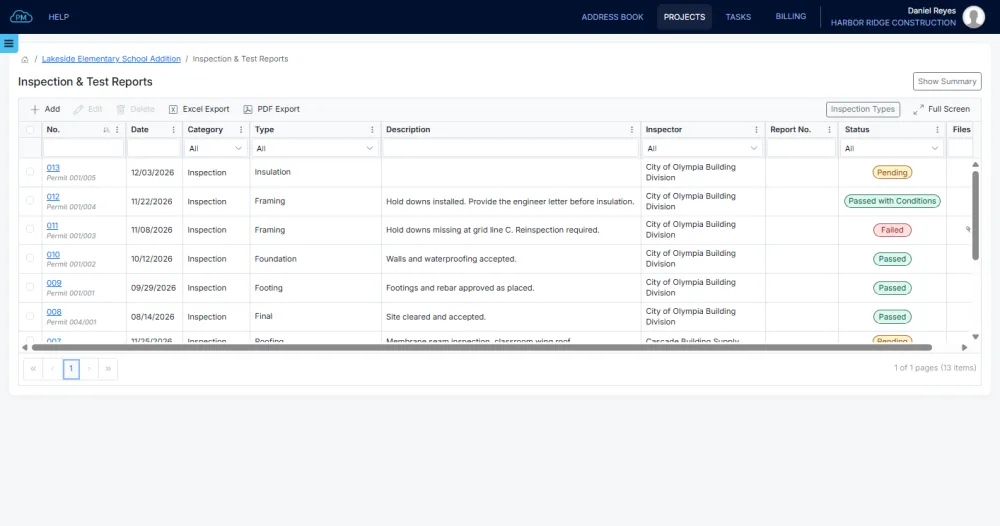
With Cloud PM, you can track every inspection and test on a project in one log, along with its status and the report from the testing firm. For each record, you can describe what was inspected or tested, select the testing firm from the project directory, and enter the report number and the inspector’s comments when the report arrives.
A failed test stays in the log, and you can add the retest as a new record with its own date, report number and status. You can upload the report to each record, and Cloud PM records who uploaded each file and when. The inspections on your construction permits are also shown in the log, so you don’t need to enter them twice.
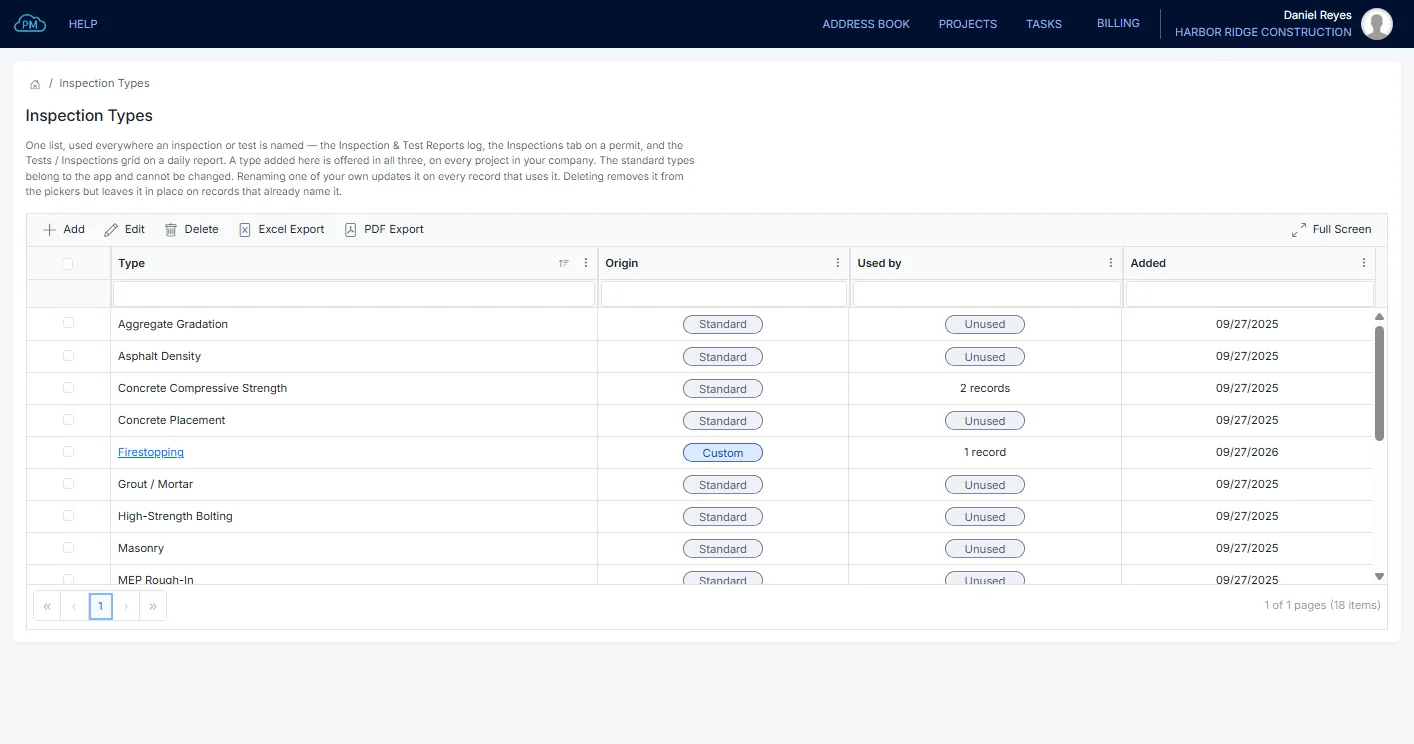
Your company has one list of inspection and test types, which you can use on these records, on your construction permits and on your daily reports, so each type has the same name on every project.
Each inspection and test is also added to the daily report of the same day, so the daily reports and the inspection log always match. The other companies on the project use Cloud PM free of charge, and plans start from $40 a month. Learn more about Cloud PM inspection and test reports.
Frequently Asked Questions
What does ITP mean in construction?
ITP means inspection and test plan. It lists the inspections and tests planned for a part of the work, when they happen, who performs them, what they are checked against and which record shows that they were done.
Who prepares the ITP?
The ITP is usually prepared by the general contractor or by the subcontractor responsible for the work, based on the specifications and the statement of special inspections. It is often submitted to the architect or the owner for review, like a submittal, before the work starts.
What is the difference between an ITP and a quality control plan?
A quality control plan describes how the contractor manages quality on the whole project: the people responsible, the procedures and how problems are corrected. An ITP is more detailed and covers one part of the work, with each inspection and test listed. A quality control plan usually includes several ITPs.
What happens if work is covered before a hold point inspection?
The inspector can ask for the work to be opened up so it can be inspected, at the contractor’s cost, and the next step stays on hold until it passes. That is why hold points should be marked clearly in the ITP and in the schedule. Defects found later go on the punch list.