
On most construction projects, subcontractors do most of the work. The general contractor’s job is to choose the right ones, keep them coordinated and make sure each one delivers its part of the work on time, to the specifications and within its contract. That is subcontractor management, and how well it is done decides much of how the project turns out.
In this post we go through the subcontractor management process from prequalification to closeout, what to include in a subcontractor management plan and the best practices that make it work. Then we show how subcontractor management works in Cloud PM.
What Is Subcontractor Management?
Subcontractor management is how a general contractor selects, hires, coordinates and pays its subcontractors, and how it tracks their documents and performance from the start of a project to its end. It covers the paperwork, such as contracts, insurance certificates and lien waivers, and the daily work, such as schedules, submittals and the quality of what gets built.
The general contractor stays responsible to the owner for all of the work, including the work it subcontracts. A problem with one subcontractor, such as a late delivery or an expired insurance certificate, becomes the general contractor’s problem, which is why it pays to manage subcontractors with a clear process.
The Subcontractor Management Process
Here are the steps on most projects:
- Prequalify. Before you invite a subcontractor to bid, check its experience, references, financial strength, safety record, licenses and insurance, and how it performed on your earlier projects.
- Bid and select. Send the bid package with a clear scope, compare the proposals on the same basis and pick the best value, not only the lowest price. Learn more about the construction bidding process.
- Sign the subcontract. Put the scope, price, payment terms, schedule, insurance and flow-down requirements in writing. See what to include in a construction subcontract agreement.
- Collect the documents before work starts. Get the certificate of insurance, the licenses, the bonds if required and the safety documents, and note their expiration dates.
- Coordinate the work. Share the schedule, hold regular meetings and track each subcontractor’s submittals and RFIs, so the trades don’t get in each other’s way. Record the crews and the work done in your daily reports.
- Manage changes and payments. Price and approve change orders in writing, review each payment application against the work in place, hold the retainage and collect a lien waiver with every payment.
- Monitor quality, safety and progress. Inspect the work, keep track of what is behind schedule and deal with problems early, in writing.
- Close out and rate. Collect each subcontractor’s closeout documents, complete its punch list work, release the retainage and rate its performance for the next project.
What to Include in a Subcontractor Management Plan
A subcontractor management plan writes down how your company manages subcontractors, so every project follows the same process. Some owners and contracts ask for one. A simple plan includes:
- Prequalification criteria. What a subcontractor must show before it can bid, such as years in business, references, safety record, licenses and minimum insurance limits.
- Selection. How bids are requested, compared and approved, and who makes the final decision.
- Required documents. The documents each subcontractor must provide before it starts, and how they are kept current when they expire.
- Communication. Who the point of contact is on each side, how often meetings are held and how instructions and changes are given in writing.
- Safety and quality. The safety and quality requirements, and how the work is inspected.
- Changes and payments. How change orders are priced and approved, and how pay applications, retainage and lien waivers are handled.
- Performance reviews. How each subcontractor is rated at the end of its work, so the ratings guide who you hire next time.
- Risk management. How you protect the project if a subcontractor falls behind or fails, such as bonds, insurance, backup subcontractors and the termination terms in the subcontract.
Best Practices for Managing Subcontractors
- Make the scope clear. Most disputes start with a scope that wasn’t clear. Say what is included and what is not, with the drawings and specification sections that cover it.
- Put everything in writing. Instructions, changes and approvals given only on site are easy to dispute later.
- Keep the documents current. An expired insurance certificate can leave you exposed if there is an accident. Track the expiration dates and ask for new certificates before they expire.
- Pay on time. Subcontractors who are paid on time keep their crews on your project. Review pay applications quickly and pay as the subcontract says.
- Measure performance. Rate each subcontractor at the end of its work on price, quality, safety and schedule, so you know who to hire again.
- Treat subcontractors as partners. Good subcontractors have a choice of general contractors. The ones who are treated fairly give you better prices and their best crews.
Managing Subcontractors in Cloud PM
With Cloud PM’s Address Book, you can manage the subcontractors and suppliers you work with across all your projects. You can organize them by categories and trades, and see each company’s documents, its rating and the projects it has worked on with you before you hire it again.
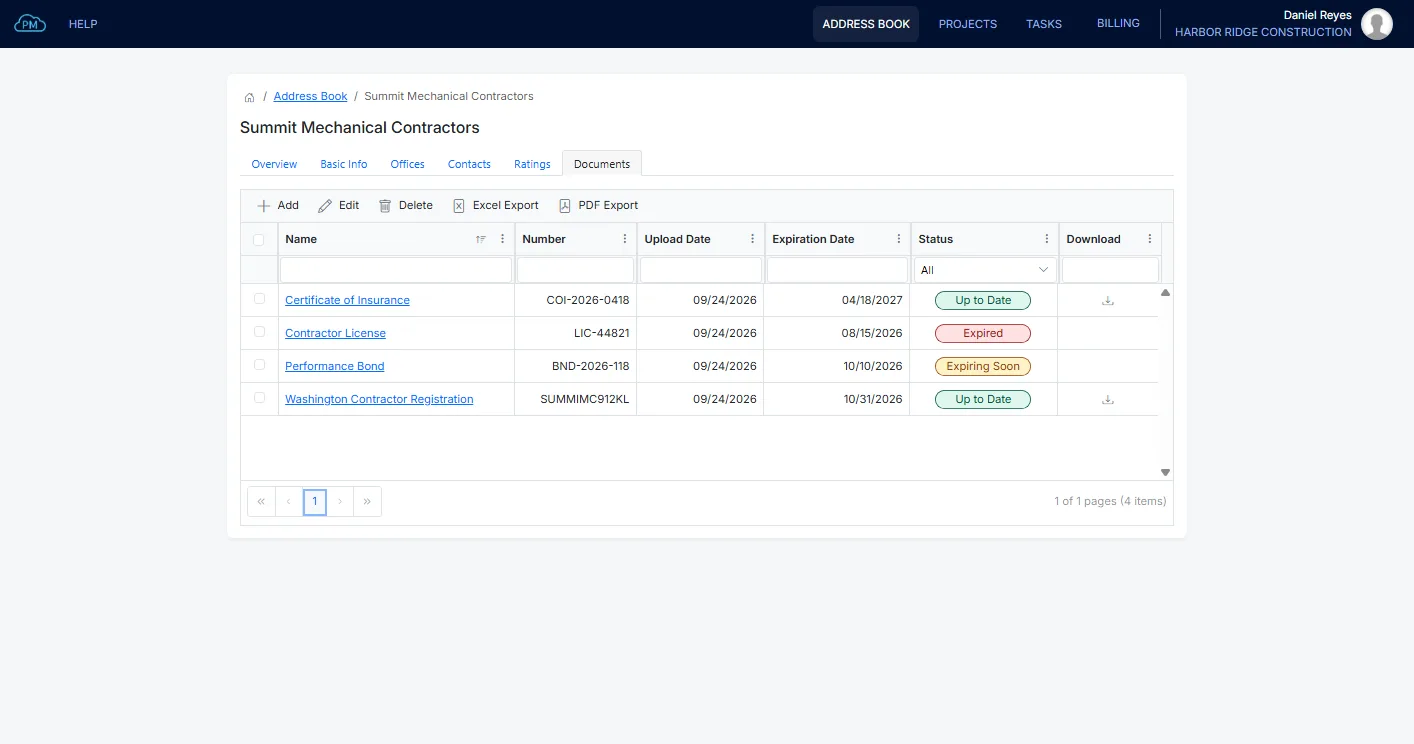
For each company, you can save its documents, such as the certificate of insurance and the license, with their expiration dates. Cloud PM can send a reminder before a document expires, so you can ask the company for a new one in time, and you can filter the documents by status to see which ones are expiring soon or have already expired.
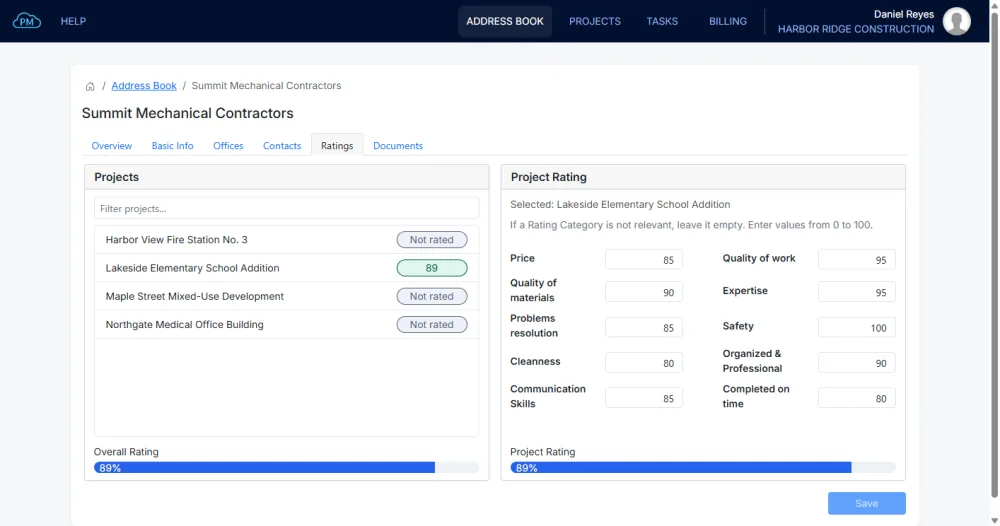
After a company has worked on one of your projects, you can rate its performance in ten categories, such as price, quality of work, safety and completing on time. Cloud PM calculates the average rating across all your projects, so you can see how a subcontractor has performed before you invite it to bid.
Each project has its own Project Directory, where you can add the companies working on that project and invite their contacts. When you create a submittal or any other record, you can select the subcontractor directly from the Project Directory. The other companies on the project use Cloud PM free of charge, and plans start from $40 a month. Learn more about Cloud PM subcontractor management.
Frequently Asked Questions
What is subcontractor prequalification?
Prequalification is checking a subcontractor before you invite it to bid: its experience, references, financial strength, safety record, licenses and insurance. It keeps companies that can’t do the work, or can’t afford to finish it, off your bid list.
What is the difference between a subcontractor and a supplier?
A subcontractor performs part of the work on site, such as the electrical or the drywall, usually with its own labor. A supplier provides materials or equipment, such as concrete or windows, without installing them. Both may need to be managed, but a subcontractor has more requirements, such as insurance, safety and on-site coordination.
Who is responsible for a subcontractor’s work?
The general contractor is responsible to the owner for all of the work, including the work done by its subcontractors. Each subcontractor is responsible to the general contractor for its own part, as its subcontract says.
How do you manage a subcontractor who falls behind?
Raise it early and in writing, find out why the work is behind and agree on a plan to recover, such as more crews or longer hours. If the subcontractor still doesn’t perform, the subcontract says what you can do next, such as supplementing its work or, as a last step, terminating it.